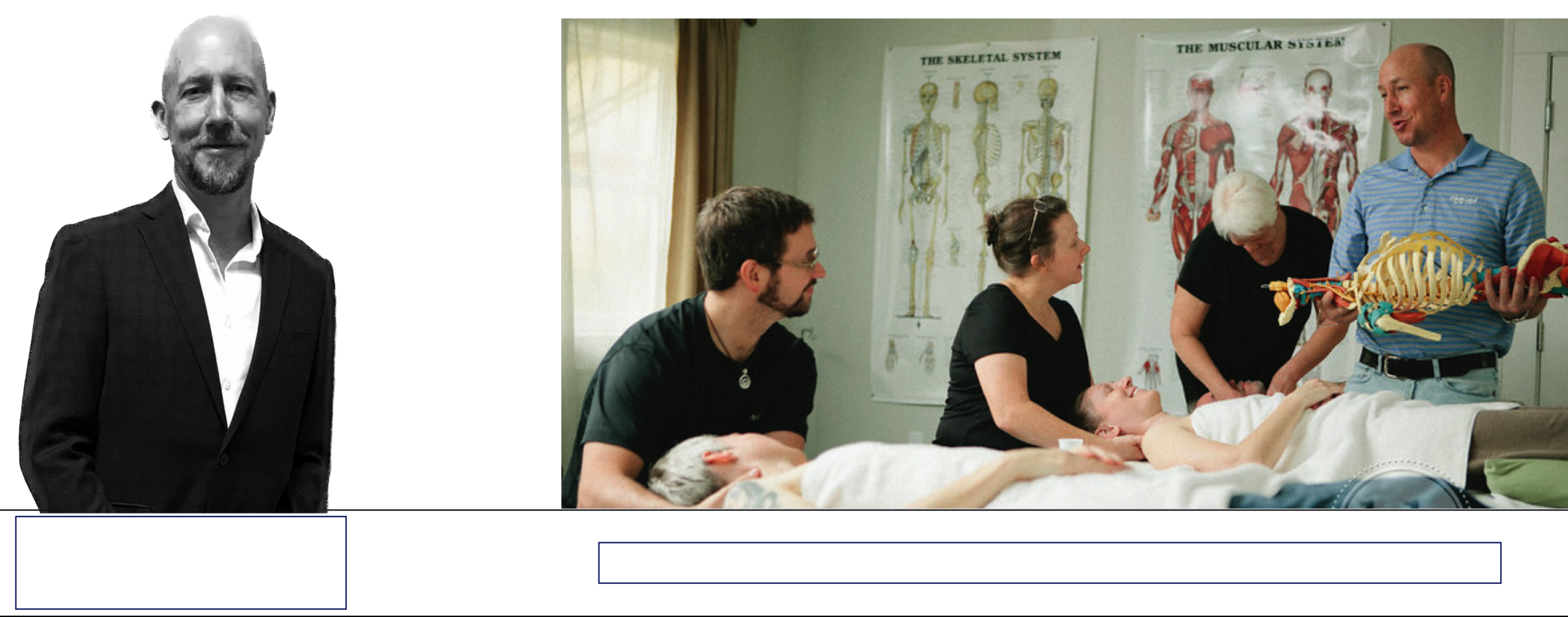
A Special Message from Kyle C. Wright, LMBT:
Clinical Massage Therapy, one of more than 500 different types of massages, uses touch to manipulate soft tissues throughout the human body. Patients seek massage therapists for a number of reasons, including decompressing tired muscles, reducing stress, and supporting general health.
We have added “Structural” to the title for reasons you will see below. [<== I added this line ~DSL]
Clinical / Structural Massage Therapy uniquely focuses on the treatment of soft tissue to maintain, develop, augment, or rehabilitate the patient’s physical function. Clinical massage therapy can improve the functioning of joints and muscles, the healing process, metabolism and circulation.
For over two decades, I’ve had the privilege of being a part of one of the fastest-growing professions in health care: Massage Therapy. In 1990, I started my first Clinical Massage Therapy school, eventually evolving into five schools throughout the southeastern United States. The well-planned curriculum enabled students to graduate with the skills making them employable and able to meet the growing demand for clinically trained massage therapists.
When I started my first class with six quality dedicated students, I never imagined witnessing over 20,000 [?NUMBER? Needs to be fact checkable by the FTC] students graduate with the same level of determination I had when I graduated from massage therapy school.
In the years since starting that first school, I have had the good fortune and freedom to experiment with new and innovative approaches to soft-tissue therapy. It is not always easy, and often even risky, to be an early adopter of new ideas and techniques. This is especially true when the ideas go against the common understandings and practices of the day.
At the time, these practices included much of what I had previously been taught by leaders in the field. Yet, the techniques my previous schools have been teaching for nearly 30 years are steadily working their way into acceptance by mainstream massage educators and practitioners.
I firmly believe Schools of Advanced Bodywork will bridge the best of traditional massage and bodywork with cutting-edge clinical therapy techniques and practices.
David Scott Lynn (DSL EdgeWork: Mindful Medical Massage & Yoga Therapeutics w/ Myo-Structual Balancing) contributed and collaborated with me in the writing, research, and development of my textbook, “Structural Balancing: A Clinical Approach, as well as for teaching me his philosophy and sharing his effective psycho-muscular balancing techniques.
In the mid-1990s, David had taught me how to reach deeper levels into the body without producing pain in the client. The main things I learned from David were about playing the physical and mental “Edges” and his theory on Chronic Excess Musculo-Fascial & Nerve Tension & Stress (C.E.M.&.N.T.).
After incorporating his yoga and bodywork techniques in my practice and schools, I can say without reservation that his theories on muscular compensatory adaptation allowed me to take my bodywork to the next level.
David originated the term and practice of Myo-Structural Balancing & Bodywork. [<== I added this line ~DSL]
Clinical Massage Therapy and Structural Bodywork is a compilation reflecting my years of education, practice, and instruction in the field of Clinical Massage Therapy. It is a product of the beliefs I share with so many others.
One such belief is that students are entitled to superior education and individualized training so they may uphold, or excel beyond, the professional standards that they continually pursue.
The NCSAB texts and curriculum are forward-thinking and express my philosophy and interpretations of the neuromuscular and skeletal systems and their relation to the body’s structure and function. The text and graphics used at the SABs are sequenced so the fundamentals are set as the basis upon which more advanced techniques are built.
Rather than attempt to encompass a wide range of massage techniques, our program focuses more deeply on certain more focused aspects, such as Clinical Massage Therapy and Structural Bodywork, and less on other techniques. I came to write the curriculum material and the school’s syllabus to assist the students’ educational development in learning and understanding a higher-level approach to massage and bodywork therapy.
Throughout my career, I built a strong following and reputation for being a goal and results-oriented bodyworker, working on people suffering from musculoskeletal pain.
The Structural Component
My approach to bodywork addresses and eliminates postural distortions caused by excess muscular tension and imbalances. Through my experience, I see many of the painful afflictions people suffer from are caused by gravitational force being applied to their bodies and the way their body painfully opposes it.
Most often (and rarely mentioned in modern medical practices) is the lack of understanding of how postural distortions have a direct and negative effect on the body.
This negative effect is often from the upper body being pulled down and forward, literally compressing the body molecule by molecule. On top of that, most people are not even aware that poor posture eventually leads to musculoskeletal pain & pathology.
Through practice, I’ve evaluated and treated thousands of people suffering from chronic pain. Most of the time, musculoskeletal pain is caused by the way the body opposes gravity inefficiently, meaning their body weight has shifted off their bones and onto their muscles.
This body shifting, altering, and compensation often leads to a constant barrage of trigger point formation, referral of pain to distant areas, deviations (unevenness) in apparent leg lengths, distortions in the pelvis and spine (misalignments), depressed or elevated shoulder girdles, as well as causing a collapsed (stooped or slouched) upper body and forward head positioning.
My objective in sharing this approach is for my instructors to train our students to start focusing on muscles that are overly and chronically “locked short” from Chronic Excess Musculo-Fascial & Nerve Tension & Stress (C.E.M.&.N.T.) and the muscular imbalances linking poor posture, musculoskeletal pain, and restrictions of body movements.
The SAB Curriculums:
The goal of the SAB curriculum is to prepare the students so that when they have a client on their table with complaints of muscle pain and/or restrictions, they’ll have a clearer picture and deeper levels of understanding as to what’s below the skin surface, what they’re working on, and what muscles could be causing it.
The premise of this method of bodywork is to create symmetry among muscle groups by applying effective and consciously applied massage therapy techniques and stretches to chronically over-shortened muscles, not necessarily the painful ones. This can be achieved by learning and practicing our version of “deep-tissue” work, a non-painful kind that isolates the cause of problems rather than just massaging the area of pain or complaint.
While learning at the SABs, I strongly encourage the use of repetition while learning hand placements. Repetition is extremely beneficial for students; as lessons are repeated, they become imprinted on their memories. During instructor-supervised classroom trades, students build confidence with each practice session.
My instructors also encourage students to give continuous feedback during trades between the giver and receiver, whether in the form of praise, constructive criticism, questions, or all three. Feedback further allows for academic and spiritual growth while perfecting hands-on delivery skills.
My instructors and I encourage students to explore the art and science of Clinical Massage Therapy and Structural Bodywork and everything it has to offer, as well as to expand their study and practice of massage therapy in general.
Adjunctive Therapies
The focus should not be on so-called alternative methods but on adjunctive methods.
Additionally, I recognize massage therapy as extremely effective either by itself or as an adjunct to other interventions, such as flexibility and strength training exercises, chiropractic, and acupuncture, as well as emotional and spiritual healing.
The two SAB teaching staffs have a combined 60 years of experience in the massage and bodywork profession, both in practice and instruction. It is with great pleasure that my instructors share our massage and bodywork experience, knowledge, and practical skills with you. I commend both instructors and students for choosing this course of study and profession.
I sincerely hope that together we may continue to enlighten the world about the value of massage therapy and how it fits into our healthcare system today and into the future.
Kyle’s Vision Lives On . . .
One-On-One with KYLE C. WRIGHT [OBSOLETE?]
Kyle C. Wright, LMBT, offers 1, 2, and 3-hour private bodywork sessions for those seeking pain & pathology relief at his private practice in Fairview, NC (10 minutes from downtown Asheville). My approach to massage and bodywork is to eliminate muscular imbalances and postural distortions, often causing chronic musculoskeletal pain and joint restrictions.
Deviations in leg lengths, distortions in the pelvis, functional scoliosis, and disc-related problems all have soft tissue components that will be addressed within each bodywork session.
Plantar Fasciitis, Knee, Hip, Back, and Neck Pain, as well as Rotator Cuff injuries usually stem from muscular imbalances caused by one group or groups of muscles “locking short” while another muscle is “locking long.” This is a muscular imbalance and if left untreated, often leads to chronic pain.
Injuries usually stem from repetitive motion, muscular overload, and poor posture. I specialize in postural bodywork and pain relief.